
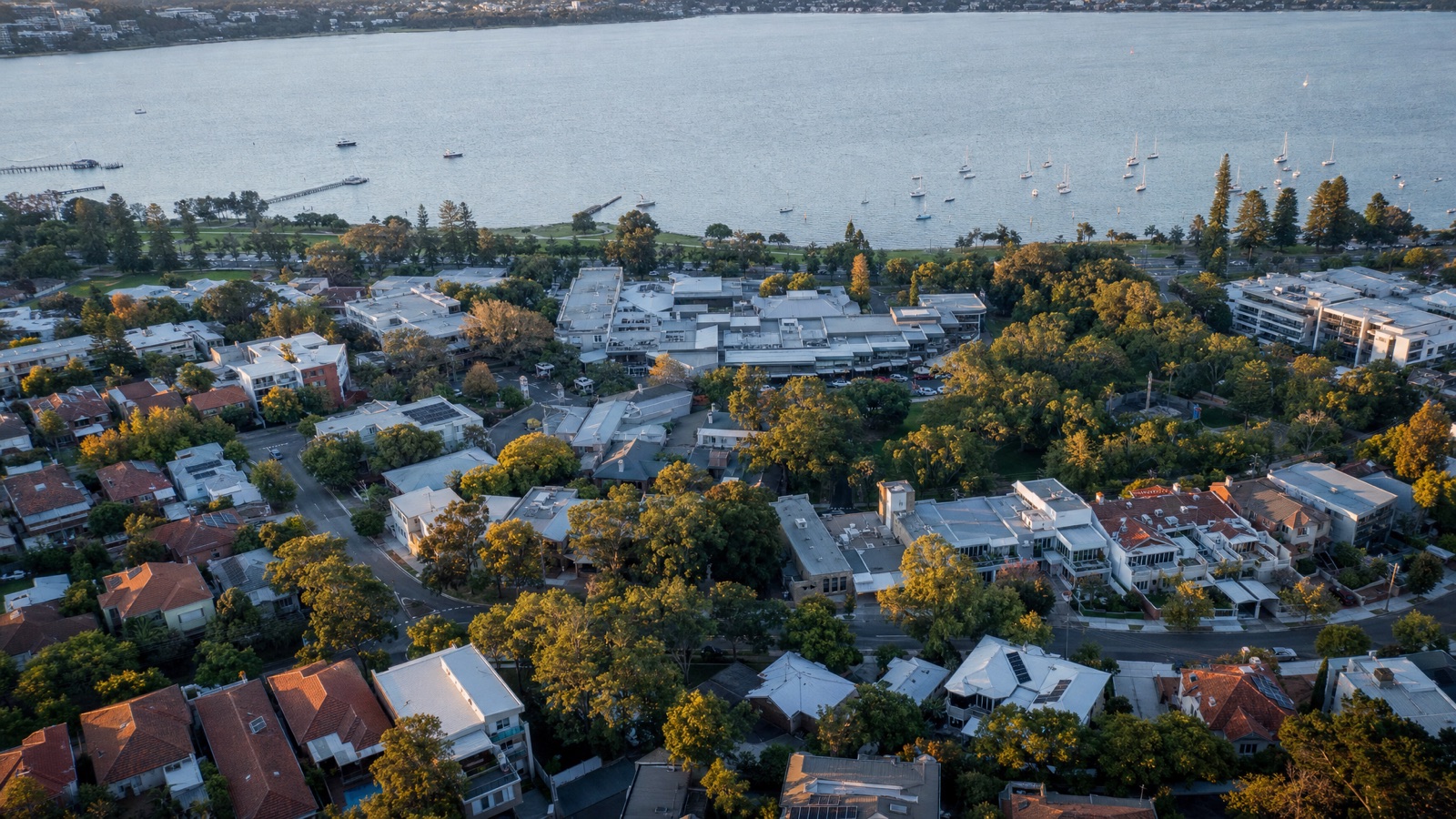
Claremont Property Investor Report
Why this suburb, why now, and what could go wrong: prices vs Perth, yields, vacancy, the supply pipeline, demographics, infrastructure and a clear strategy verdict for Claremont (6010).
Data compiled 2026. Every figure is attributed to a named source below.
The short version
Claremont is the town centre of Perth's western suburbs, and the one prestige pocket where an income investor actually has options. Alongside the multi-million-dollar houses sits a genuine apartment market built around Claremont Quarter, the train station and the river, so a third of homes here are rented, the highest share in the blue-chip belt. Houses have run hard, up around 25 to 30% over the past year, but they remain tightly held.
The investor angle is the unit. Apartments trade near $930,000 and yield around 4.1% gross, against barely 2.4 to 3% on houses, and they sit walking distance from retail, rail and some of Perth's most sought-after schools. That combination of amenity, liquidity and yield is rare in the western suburbs.
The full report below covers price trends versus Perth, rents and yields, the vacancy and supply picture, who lives here, the infrastructure driving demand, the real risks, and our plain-English verdict on who Claremont actually suits. Enter your details to read it in full.
Read the full Claremont report
Price trends vs Perth, yields, vacancy, the supply pipeline, demographics, infrastructure, risk and our strategy verdict, with every figure sourced. Enter your details to unlock it instantly.
1. Suburb snapshot
Claremont sits about 9km west of the Perth CBD on the Fremantle rail line, between the Swan River and the western-suburbs school belt. It is the commercial heart of the western suburbs, anchored by the Claremont Quarter retail precinct, the station and the Claremont on the Park development, and that gives it a character the surrounding prestige pockets lack: a real, deep apartment and rental market alongside its blue-chip houses. For investors that means two genuine plays, a tightly held, high-growth house market and a liquid, higher-yielding unit market, with amenity and transport doing the heavy lifting on demand.
2. Sales and price trends
The Claremont median house price sits around $2.2 to $2.4 million depending on the source: REIWA reports about $2.2 million with 25% growth over the 12 months to August 2025 (REIWA), while PropertyValue shows a higher $2.4 million, up almost 30% on the year (PropertyValue). Units trade near $930,000, up about 9.2% over the year (property.com.au).
Both segments outran the wider city. Over the past year Perth's median house price rose roughly 18% to about $1.09 million (Domain via ABC News); Claremont houses grew faster still. That is unusual for a prestige suburb, and reflects Claremont's broader buyer base: it draws not just top-end house buyers but downsizers and professionals competing for apartments near the Quarter and the station.

"Claremont is the one western suburb where I actively look at apartments for clients. Everywhere else around here the unit market is an afterthought, but Claremont has the Quarter, the train and the school run all in walking distance, so there's a real tenant pool and real resale demand. The trap is treating every apartment the same. A well-built place a block from the Quarter with parking is a different asset to a dated walk-up on Stirling Highway. The address inside the suburb matters as much as the suburb."

3. Rental market and yield
Houses rent for roughly $1,200 to $1,250 a week at a gross yield of only about 2.4% to 3.0% (property.com.au; Blackburne), the usual prestige pattern where rent does not cover the cost of holding the asset.
Units are the income story: about $710 to $770 a week at a gross yield near 4.1% (property.com.au; RealEstateInvestar), and unlike most of the western suburbs there are enough of them to build a genuine income position. That yield, off a sub-$1 million entry, into a tightly held postcode with this much amenity, is the single most important number in this report.
Units yield well above houses off a far lower entry price, and Claremont has the depth of stock to act on it.
4. Supply and demand indicators
Demand is strong and the market is liquid by prestige standards. Claremont's vacancy rate sits near 1.0% (RealEstateInvestar), below the 2.5% to 3.5% range generally considered balanced for Perth, and turnover is healthy: roughly 90 to 95 houses and over 120 units sold in the past year, with houses averaging only about 14 days on market (PropertyValue; Blackburne).
Supply is the variable that defines Claremont, because it is the western suburbs' designated higher-density node. The Claremont on the Park precinct beside the station and the Claremont Quarter have already added apartments, and the western suburbs councils are under state pressure to deliver more infill around train stations, with Claremont and the Curtin Avenue corridor squarely in scope (western suburbs councils). Specific approval counts are not published in the property data, but the direction is clear: more apartment supply will land here than in the surrounding suburbs, so unit stock selection matters.
"The same density push that makes Claremont liquid is also its main risk on the unit side. The state wants more apartments around this station, so if you buy a brand-new off-the-plan unit you may be competing with the next release in a couple of years. My preference here is established stock with a genuine outlook, parking and a bit of scarcity to it, the things a new tower nearby can't reproduce. On the house side, anything walkable to the Quarter and the good schools is the part that stays tightly held."
5. Demographics and affordability
Claremont is high-income but more mixed than its neighbours, which is exactly what gives it an income market. The 2021 Census recorded a population of about 9,248, up roughly 13% on 2016, a median age of 44, and a median household income near $2,068 a week (ABS 2021 Census). That income is lower than Dalkeith or Nedlands precisely because so many households are renters in apartments: only about 60.7% of households are families, and a high 32.6% rent, with 39.8% owned outright. This is the tenant base that keeps the unit market working.
6. Infrastructure and growth drivers
The demand investors are buying into comes from Claremont's rare combination of retail, rail, river and schools:
- Rail and CBD access. Claremont is on the Fremantle line, with Claremont station putting the suburb roughly 15 to 18 minutes from Perth Station and a similar trip to Fremantle, a genuine car-free option in a prestige suburb.
- Claremont Quarter and the town centre. The Quarter is one of Perth's premier retail and dining precincts, and the surrounding town centre gives Claremont a walkable, amenity-rich core that very few suburbs in this price bracket can match.
- Schools. Claremont sits in the heart of the western-suburbs school belt, with Methodist Ladies' College and Christ Church Grammar in or beside the suburb, Scotch College close by, and Freshwater Bay Primary serving the local catchment, a major and durable demand driver.
- River and UWA. The Swan River foreshore and the University of Western Australia are both a short distance away, supporting both lifestyle demand and a professional and academic tenant pool.
- Town-centre renewal. Continued development around the station and Claremont Quarter will lift amenity over time, even as it adds apartment supply (see section 4).
7. Risk assessment and strategy fit
- Unit supply risk. As the western suburbs' density node, Claremont will absorb more apartment supply than its neighbours, which can weigh on unit rents and values during absorption; position and quality are decisive.
- Low house yield. House yields around 2.4 to 3% mean real holding costs each year; the house case rests on capital growth and scarcity.
- Strong recent run. Houses are up nearly 30% in a year, so you are buying after a sharp move; entry discipline matters.
- Stock variability. A mixed suburb means quality and position vary block to block; the suburb-wide median can mislead on any specific apartment.
- Liquidity is segment-specific. Houses turn over fast, but a poorly chosen apartment competing with new supply can be slower to lease and sell.
Strategy fit. Claremont suits a yield-focused investor buying a well-located unit with parking and an outlook for income plus amenity, or a high-equity buyer chasing a scarce house walkable to the Quarter and the schools for long-term growth. It is less suited to a buyer wanting generic new apartment stock and expecting it to outperform while the station precinct densifies.
8. The investor verdict
Put the pieces together and Claremont is the amenity-and-income hub of the western suburbs: blue-chip houses that have run hard and stay tightly held, set against a genuine, liquid apartment market yielding well above the prestige average, all wrapped around retail, rail, the river and the best schools in Perth. The houses are the scarcity-and-growth play; the units are the income play, with the station-precinct supply pipeline the one thing to underwrite carefully. Buy the position and quality the next tower cannot replicate, and let comparable-sales evidence and negotiation, not the asking price, decide what you pay.
Sources
- REIWA, Claremont suburb profile
- property.com.au, Claremont 6010
- PropertyValue, Claremont 6010
- RealEstateInvestar, Claremont rent, yield & vacancy
- Blackburne Property Management, Claremont
- Domain via ABC News, Perth median house price
- ABS 2021 Census, Claremont
- Western suburbs councils, infill around train stations
Thinking about buying in Claremont?
Numbers like these only get you so far. We can pull live comparable sales, pressure-test a specific property against this data, and negotiate on your behalf in Claremont.