
Rental Yield vs Capital Growth: What Perth Property Investors Should Prioritize
Every property investor faces this fundamental question: should I prioritise rental yield (cash flow) or capital growth (equity)? The answer shapes suburb selection, property type, and ultimately, your wealth-building journey.
In Perth’s market, this choice is particularly relevant. REIWA reports that in calendar 2025 the Perth unit median rose 20.0% (to $600,000) against 13.3% for houses (to $850,000), and over the 12 months to October 2026 units rose 20.7% against 16.4% for houses. Traditionally high-yield stock, like villas and units, has been keeping pace with houses. Choosing the right balance now isn’t just about cash flow; it’s about reading the market as it stands, including a cash rate of 4.85% and listings that have risen sharply.
Understanding the Trade-Off
Rental Yield is the return your property generates through rent, expressed as a percentage of its value. Capital Growth is the increase in your property’s value over time.
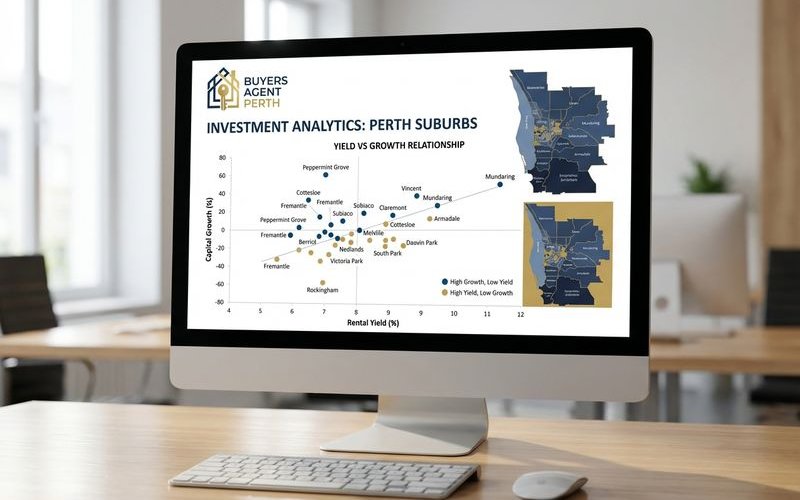
In most markets, Perth included, there is traditionally an inverse relationship between the two:
- High-yield properties often have slower growth.
- High-growth properties typically have lower yields.
This isn’t absolute, but it’s a reliable pattern. However, you must be aware of “Yield Compression.” When a high-yield suburb booms in price, the rental yield drops for new entrants because prices have risen faster than rents. Armadale is a current example: YIP/CoreLogic lists a 20.0% rise in its house median over the 12 months to August 2026 and a 4.59% gross house yield.
The Math Behind Each Strategy
Let’s look at illustrative numbers built on current medians to see how this plays out in your bank account. Both examples use YIP/CoreLogic medians for the 12 months to August 2026. The yield and net income lines are our own arithmetic on the median price and median rent, so they will not match the gross yield YIP itself publishes (Cannington units 5.61%, Scarborough houses 3.42%). The expense percentages are assumptions for illustration.
High Yield Example (Cannington Unit)
- Purchase (median unit price): $636,500
- Weekly rent (median unit rent): $700
- Annual rent: $36,400
- Gross yield (our arithmetic): ~5.7%
- Expenses (assumed 3% of price): $19,095
- Net income: $17,305
The Outcome: You have stronger immediate cash flow to help service the loan, but your land component is smaller, which can moderate long-term growth. Cannington’s unit median rose 19.0% over the same 12 months, so that is not a given.
High Growth Example (Scarborough House)
Coastal suburbs with high land value are the usual choice for long-term equity, but the holding costs are significant.
- Purchase (median house price): $1,503,250
- Weekly rent (median house rent): $1,100
- Annual rent: $57,200
- Gross yield (our arithmetic): ~3.8%
- Expenses (assumed 2.5% of price): $37,581
- Net income: $19,619
The Outcome: At a cash rate of 4.85%, the rental income covers only a fraction of the mortgage interest on a loan of this size. You are likely negatively geared, paying out of pocket monthly to hold the asset, and betting on growth. As an illustration only, a 7% to 9% annual gain on $1,503,250 would be roughly $105,000 to $135,000 a year, but that is an assumption, not a forecast.
When to Prioritise Rental Yield
You Have Limited Borrowing Capacity Banks assess your ability to service a loan based on income. High-yield properties add more to your income column than they subtract from your servicing expenses, effectively boosting your borrowing power for the next property.
You Are “Rent-Vesting” If you rent where you live and invest elsewhere, you likely need the investment property to cover its own costs so you aren’t paying rent and a mortgage shortfall simultaneously.
You’re Starting Out First-time investors often cannot stomach a $1,000/month shortfall that comes with high-growth assets. Yield-focused properties are more forgiving and allow you to enter the market without changing your lifestyle.
You’re Risk-Averse Yield provides certainty. Rent comes in monthly and is contractually obligated. Capital growth is speculative and “on paper” until you sell or refinance.
Perth High-Yield Suburbs (YIP/CoreLogic, 12 months to August 2026)
| Suburb | Median Price | Gross Yield | Character |
|---|---|---|---|
| Cannington | $790,000 (House) / $636,500 (Unit) | 4.59% (House) / 5.61% (Unit) | Major retail hub & transport |
| Bentley | $848,000 (House) / $715,000 (Unit) | 4.14% (House) / 5.05% (Unit) | Student catchment (Curtin Uni) |
| Balga | $790,500 (House) / $725,000 (Unit) | 4.77% (House) / 5.42% (Unit) | Affordable density infill |
| Maddington | $770,000 (House) / $640,000 (Unit) | 4.70% (House) / 5.39% (Unit) | Industrial & mixed-use corridor |
| Medina | $690,000 (House) | 4.45% (House) | Kwinana industrial hub |
When to Prioritise Capital Growth
You Have Secure, Surplus Income If your salary comfortably covers your living expenses and investment holding costs, you can afford to “feed” the property. You are essentially buying $1 worth of future assets for 90 cents today.
You’re in High Tax Brackets If you are in the top marginal tax bracket, negative gearing has traditionally offset a large share of your holding losses against your other income. The federal 2026-27 Budget announced changes for established homes bought after 7:30pm AEST on 12 May 2026: from 1 July 2027, losses on those properties can only be offset against residential property income and carried forward, and the 50% capital gains discount would be replaced by an inflation-based discount with a minimum 30% tax rate on gains. Under the announcement, properties held before it keep the existing negative gearing treatment, and new builds remain eligible. Source: Treasury, Budget 2026-27 tax system changes. We have not confirmed legislative status, so speak to your accountant before relying on either rule.
You Have Long Time Horizons Growth compounds over time. A 7% growth rate doubles your asset’s value in roughly 10 years. Five years might be flat, and Perth has had flat stretches in the past, but a long holding period has historically rewarded patient capital growth investors.
You Want to Manufacture Equity Growth suburbs often allow for cosmetic renovations or subdivisions. Adding value to a Scarborough house (YIP/CoreLogic median $1,503,250) can yield a far higher dollar return than renovating a lower-priced unit.
Perth Capital Growth Suburbs (YIP/CoreLogic house medians, 12 months to August 2026)
| Suburb | Median House Price | 12-month Growth | House Sales in Period | Character |
|---|---|---|---|---|
| Scarborough | $1,503,250 | 19.5% | 182 | Premium coastal revitalisation |
| Samson | $1,190,000 | 19.2% | 12 | Tightly held family enclave |
| Brentwood | $1,530,000 | 30.2% | 24 | Applecross High School zone |
| Mandogalup | $880,000 | 3.8% | 31 | New corridor nearing capacity |
| Trigg | $2,887,500 | 25.5% | 40 | Exclusive coastal blue-chip |
Samson, Brentwood and Mandogalup each had fewer than 35 house sales in the period, so their medians move more than a high-volume suburb’s. Mandogalup’s 3.8% suggests that a “growth corridor” label does not guarantee growth.

The Balanced Approach: The “Villa” Sweet Spot
With house prices in premium suburbs out of reach for many buyers, demand has spilled over into villas and townhouses in those same areas. That gives you a useful hybrid:
- Better Yield: Units often yield more than houses in the same suburb. In YIP/CoreLogic data for the 12 months to August 2026, Victoria Park units yield 5.07% against 3.43% for houses, and Maylands units 5.08% against 3.36%.
- Land Content: Unlike apartments, you own a portion of the land (strata), which drives growth.
- Growth Catch-Up: REIWA reports that in calendar 2025 Perth units grew 20.0% against 13.3% for houses.
Perth Balanced Suburbs (YIP/CoreLogic house medians, 12 months to August 2026)
| Suburb | Median House Price | Gross Yield | 12-month Growth | Why It Balances |
|---|---|---|---|---|
| Thornlie | $860,000 | 4.32% | 21.1% | Thornlie-Cockburn Line (opened June 2025) |
| Morley | $975,000 | 4.02% | 18.2% | Morley-Ellenbrook Line (opened December 2024) |
| Gosnells | $765,000 | 4.59% | 21.4% | Revitalisation & affordability |
| Wandi | $955,000 | 3.93% | 24.0% | Family demand + freeway access |
Portfolio Strategy: Not Either/Or
Sophisticated investors don’t choose between yield and growth, they balance their portfolio to keep borrowing.
The “Borrowing Capacity” Trap If you buy three high-growth, low-yield properties (e.g., negative gearing $15k/year each), you will likely hit a “servicing wall” with the banks. They won’t lend you more money because your cash flow is too poor.
Typical Portfolio Evolution
Phase 1: Foundation (Properties 1-2)
- Focus: Balanced or High Yield.
- Goal: distinct from “quick wins,” the goal here is to secure assets that don’t hurt your lifestyle. A unit or villa in Cannington (YIP/CoreLogic unit median $636,500) can provide a base without eating your monthly wage.
Phase 2: Acceleration (Properties 3-4)
- Focus: Capital Growth.
- Goal: Use the equity from Phase 1 and your remaining serviceability to buy a “heavy lifter”, a property with high land value in a scarce suburb like Scarborough or Victoria Park.
Phase 3: Consolidation (Properties 5+)
- Focus: High Yield / Commercial.
- Goal: Improve overall portfolio cash flow to prepare for retirement or debt reduction.
Impact of Leverage
Leverage (using borrowed money) amplifies both strategies, but it also amplifies the risks.
High Yield + Leverage
- Positive cash flow increases with scale.
- Insider Tip: Watch out for the WA Land Tax Threshold. It kicks in once the unimproved value of your landholdings exceeds $300,000. If you buy three cheap houses in Armadale, you might inadvertently cross this threshold, and the tax bill will eat your positive cash flow.
High Growth + Leverage
- Equity grows faster. A 10% gain on a $1M property ($100k) is far more impactful than a 10% gain on a $400k property ($40k).
- Risk: Interest rate sensitivity. A 1% rise in rates on a $1M loan adds $10,000 to your annual costs. You need a significant financial buffer.
Example: $1M Investment Capacity
Option A: Two balanced properties ($500k each)
- Diversified across two locations.
- Risk of vacancy is spread (unlikely both are empty at once).
- Land tax might stay under the radar if land values are low.
Option B: One high-growth property ($1M)
- Single tenant risk (100% vacancy if they leave).
- Higher quality asset, likely better long-term capital appreciation.
- Lower maintenance hassle (one roof vs two).
Market Cycle Considerations
Yield and growth preferences should adapt to where Perth sits in the property clock.
Early Cycle (Recovery)
- Yields are often high because prices are still low.
- Strategy: Buy Growth. This is when you pick up the “bargains” in blue-chip areas before the masses return.
Mid Cycle (Expansion - Perth 2024 to mid-2026)
- Prices rise rapidly, compressing yields. REIWA reports that growth slowed sharply in the September 2026 quarter and that quarterly medians fell in the June and September quarters, so this phase may be ending.
- Strategy: Pivot to “Laggards.” When houses become too expensive, the demand shifts to units and villas, as REIWA’s 2025 figures (units up 20.0%) show.
Late Cycle (Peak)
- Yields are at their lowest; affordability is stretched.
- Strategy: Focus on Yield and debt reduction. Don’t speculate on further massive growth.
Tax Implications
Understanding the tax layer is crucial for your net result.
Rental Income vs. Capital Gains Rental income is taxed at your marginal rate today. Capital gains are taxed only when you sell. Under current law you get a 50% discount if you’ve held for over a year, but the 2026-27 Budget announced that it would be replaced from 1 July 2027 with an inflation-based discount and a minimum 30% tax rate on gains. Under the announcement, gains that accrue before 1 July 2027 keep the 50% discount, and new-build buyers can choose either method (Treasury, Budget 2026-27 tax system changes). Get advice for your own situation.
Depreciation (Division 43 vs 40) Don’t ignore depreciation. A newer high-yield property (or a newly built one) offers significant non-cash deductions.
- Division 43: Capital works (the building itself).
- Division 40: Plant and equipment (blinds, ovens, carpets).
- Tip: You can often turn a slightly negative cash flow property into a “cash flow positive after tax” investment just by claiming these correctly.
Negative Gearing For a clear example under the current rules: If your marginal rate is 45% and you lose $10,000 in cash flow on a property, the tax saving is $4,500, so your “real” cost to hold the asset is $5,500. Under the announced changes, from 1 July 2027 that offset against wages would no longer be available for established homes bought after 12 May 2026, so check how the changes apply to you.
Your Investor Profile
Consider which profile matches your situation:
The Security Seeker
- Priorities: Stable income, low stress, sleep-at-night factor.
- Best strategy: High Yield (Commercial or Residential).
- Ideal suburbs: Established, affordable areas like Balga or Medina.
The Wealth Builder
- Priorities: Maximum net worth capability, delayed gratification.
- Best strategy: High Capital Growth.
- Ideal suburbs: Coastal or Near-City (Scarborough, South Perth, Leederville).
The Balanced Investor
- Priorities: Hedging bets, sustainable portfolio growth.
- Best strategy: “Sleeper” suburbs or Villas in blue-chip areas.
- Ideal suburbs: Middle-ring with infrastructure upgrades (Morley, Thornlie).
Making Your Decision
Questions to guide your strategy:
-
What is your borrowing capacity right now?
- Maxed out? → You need Yield to service the next loan.
- Plenty of room? → You can afford to target Growth.
-
What is your legitimate risk tolerance?
- Can you cover a $4,000 hot water system replacement without panic? If not, you need the cash flow buffer of a yield property.
-
What is your timeline?
- Under 5 years? → Don’t rely on growth; it’s too volatile. Stick to Yield.
- 15+ years? → Growth will almost always outperform yield.
-
Have you checked the Land Tax threshold?
- If you already own property, check if your next purchase pushes your aggregated land value over $300k (or the next bracket at $420k). The tax bill might shock you. These thresholds are the ones on the WA Treasury and Finance land tax page (last updated 20 May 2026).
The Perth Advantage
Perth’s investment landscape offers genuine choice in 2026. In YIP/CoreLogic data for the 12 months to August 2026, unit yields of 5% or more appear in suburbs such as Cannington (5.61%), Balga (5.42%) and Maddington (5.39%), though house yields in the same suburbs are 4.6% to 4.8%.
Supply is still catching up with population growth: the ABS records 25,505 WA dwelling commencements against 19,638 completions over the four quarters to June 2026 (our sum of seasonally adjusted quarters). But REIWA reports that listings for sale have risen sharply, and REIWA’s president has said the federal tax changes have led investors to retreat from established homes (REIWA, 19 October 2026), so we would not assume prices stay firm.
A licensed buyer’s agent, if engaged, can analyse both yield and growth factors. For more on specific areas, browse the Perth suburb guides.
Topics
Related Guide
A plain-English guide for property investors: setting a strategy, comparing yield and growth, analysing suburbs, running the numbers, and doing due diligence before you buy.
Read: Investment GuideBuyers Agent Perth
Buyers Agent Perth publishes property guides. It is not a licensed real estate agency and does not act for property buyers or sellers.