
Perth’s property market has shifted dramatically over the last five years, moving from a prolonged recovery to becoming the nation’s standout performer. As we settle into 2026, buyers need to look beyond the headline growth figures and understand the specific forces now shaping prices.
Separating hype from fundamentals is hard when the market is moving this fast. Our team has gone through the latest economic indicators and on-ground transaction data to clarify exactly what is happening, and what we see is a landscape defined by critical supply shortages against a changing economic backdrop. This analysis breaks down the real numbers, the emerging opportunities, and the strategic moves smart buyers are making right now.
Market Position: Where We Stand
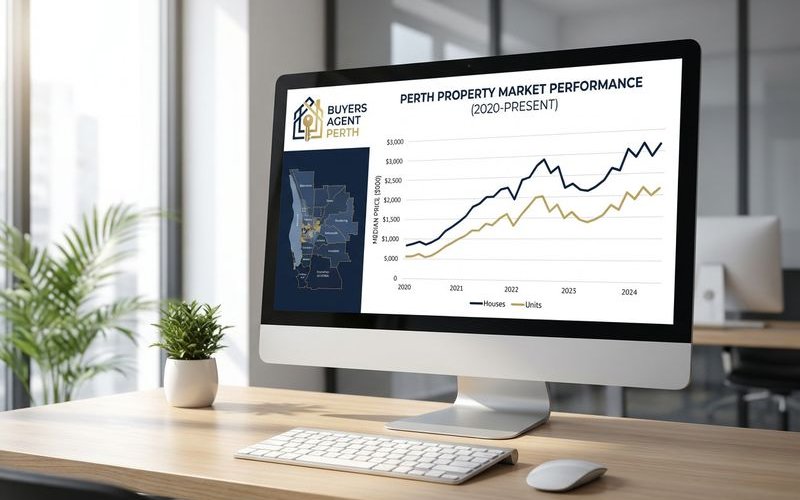
Perth enters 2026 with real momentum, though the pace has eased from the frenetic energy of previous years.
Recent Performance
- 2023: +9.8% growth (Recovery phase)
- 2024: +15.2% growth (Peak acceleration)
- 2025: +8.4% growth (Stabilization phase)
- 5-year cumulative: ~45% total appreciation
Current Metrics (Early 2026)
- Median house price: ~$745,000 (Revised from earlier estimates)
- Median unit price: ~$465,000
- Vacancy rate: 0.6% (Remains at crisis levels)
- Days on market: 14 days for high-demand suburbs
The market has fundamentally reset. Current inventory hovers around 3,500 listings, well below the 12,000 a balanced market would need.
Supply Dynamics: The Fundamental Driver
Prices here are ultimately dictated by a severe imbalance between the homes available and the people who need them.
Population Growth
Net Interstate Migration Western Australia continues to lead the nation on population growth as a percentage. Families are still relocating from Sydney and Melbourne, where median prices exceed $1.4 million, the resource sector and related service industries are actively recruiting, and fewer Western Australians are leaving for the east coast than the historical average. We see this daily in client inquiries originating from New South Wales and Victoria.
International Migration Borders are fully open and the impact is compounding. The State Nominated Migration Program (SNMP) has prioritized construction and healthcare workers, while international student enrollments have returned to pre-pandemic levels, putting immense pressure on inner-city rentals.
The Bottom Line WA’s population is expanding by over 80,000 people annually. That requires roughly 30,000 to 35,000 new homes a year just to stand still.
Dwelling Supply vs. Demand
Construction Constraints The building industry is trying to catch up, but structural hurdles remain. Competition from the mining sector keeps trade rates high, finishing a standard single-storey home now costs 30% more than it did in 2020, and average build times still hover around 12-14 months for brick construction even as they slowly improve.
The Deficit by the Numbers
| Metric | Annual Figure |
|---|---|
| New Household Formation | ~32,000 households |
| Net Dwelling Completions | ~17,500 dwellings |
| Annual Shortfall | ~14,500 dwellings |
This cumulative shortfall is the primary floor under property prices.
Land Supply
Perth’s Geographic Challenge Urban sprawl is running into hard physical barriers: the Indian Ocean to the west, the Darling Scarp (Perth Hills) to the east, and environmental constraints and protected bushland to the north and south. Because of that scarcity, we are advising clients that land value in established suburbs will likely outperform house-and-land packages on the fringe.
Price Forecast: 2026 Outlook
Any honest forecast has to weigh several possible futures, each driven by a different set of economic triggers.
Scenario Analysis Table
| Scenario | Probability | Projected Growth | Key Triggers |
|---|---|---|---|
| Conservative | 20% | 3-5% | RBA hikes rates; Commodity prices drop significantly; Migration slows. |
| Base Case | 50% | 5-8% | Rates hold/slight cut; Employment stays strong; Supply gap persists. |
| Optimistic | 30% | 8-12% | Aggressive rate cuts; Resource boom accelerates; Investors flood market. |
Segment Variations
Averages tend to hide the truth about specific sub-markets.
Houses vs. Units Land content remains king. Houses in the middle ring ($750k-$1.1M) are seeing the most aggressive competition, and while units are closing the gap slightly as yield-seeking investors move in, the capital growth disparity remains.
Premium Market ($1.5M+) This segment is far more sensitive to sentiment. It stabilized in late 2025, but it is poised to move if interest rates soften.
Economic Factors
Property prices never move in isolation from the wider economy, and a few levers matter more than the rest.
Interest Rates
The Reserve Bank of Australia’s decisions remain the primary lever on borrowing capacity.
Current Position We are in a “hold” cycle, with markets pricing in potential relief later in the year. Serviceability buffers (the 3% stress test) continue to cap maximum loan sizes, but many borrowers have transitioned off fixed rates without the mass forced-selling that was initially feared.
Rate Sensitivity Perth is generally less leveraged than Sydney, so a 0.25% rate cut acts as a real confidence booster here and tends to accelerate activity more than it does in the debt-heavy eastern capitals.
Employment & The State Economy
The Resource Backbone Iron ore and LNG exports hand the state government budget surpluses, which fund heavy infrastructure spending without debt blowouts. Major projects in the Pilbara and the shift into green-energy minerals like lithium and nickel are creating a steady stream of high-income roles.
Diversification It is not just about mining anymore. The AUKUS deal is driving investment in the Henderson maritime precinct, creating long-term, secure employment across the southern corridor.

Emerging Growth Corridors
Infrastructure transforms accessibility, and accessibility drives value.
Northern Corridor
Metronet Impact: Yanchep Line Now that the rail extension to Yanchep is operational, we are seeing the second wave of growth. Yanchep is shifting from a holiday spot to a viable commuter suburb, and the transit-oriented developments at Eglinton and Alkimos are maturing, drawing young families priced out of Joondalup.
Growth Potential: High. The connectivity is now proven, not just promised.
Eastern Corridor
The Ellenbrook Game Changer The Ellenbrook rail line is fully active and has roughly halved commute times to the CBD. Values in Ellenbrook are adjusting to reflect its new status as a connected hub, while the industrial and commercial precincts around Malaga are intensifying and driving demand for nearby housing in Bennett Springs and Dayton.
Growth Potential: Significant. This corridor was long undervalued because of its isolation, and that discount is disappearing.
Southern Corridor
Thornlie-Cockburn Link This east-west connection is unusual because it links two major train lines. Canning Vale is already a premium family suburb, and the new stations fill the last gap in its amenity list, while the Nicholson Road precinct is emerging as a key transport node.
Growth Potential: Moderate to High. Focus on established homes within 800m of the new stations.
Segment Analysis
First Home Buyer Market
The Reality First home buyers face the stiffest competition, with properties under $650,000 drawing the highest number of offers per listing. Two tactics consistently pay off: hunt for the “ugly ducklings”, structurally sound 1980s and 90s homes that only need cosmetic updates, and favour older suburbs with larger blocks like Gosnells, Armadale or Camillo over the new tiny blocks on the fringe.
Investment Market
Yield vs. Growth Yields have compressed as prices rose, but Perth still offers some of the best returns in Australia.
| Strategy | Target Areas | Typical Yield | Capital Growth Outlook |
|---|---|---|---|
| Balanced | Balga, Girrawheen, Rockingham | 5.0% - 5.5% | High |
| Growth | Padbury, Willagee, Duncraig | 3.5% - 4.2% | Very High |
| Premium | Subiaco, South Perth | 2.8% - 3.5% | Moderate (Long Term) |
Upgrader Market
The Opportunity Equity is the upgrader’s best friend right now, with many homeowners sitting on $150k-$200k of unplanned growth from the last 24 months. The gap between median and premium suburbs hasn’t blown out the way the lower end has, which makes this a smart time to trade up.
Risk Factors to Monitor
Prudent buyers always keep an eye on the downside.
Commodity Price Volatility
WA’s economy is still tied to China’s demand for iron ore. A significant, sustained crash in commodity prices would hit state revenue and sentiment, though the direct effect on Perth property usually lags by 12-18 months.
Building Sector Stability
If major builders collapse, it scares off off-the-plan buyers. That paradoxically pushes up the price of established homes, but it also creates broader economic uncertainty.
Regulatory Changes
Watch the R-Codes (zoning laws). The state government is pushing for density, which could suddenly lift supply potential in specific low-density suburbs and shift values.
Strategic Recommendations
For Buyers
Decision Making Time in the market beats timing the market. If you are buying a home to live in for the next decade, the exact entry price matters far less than the quality of the asset.
Suburb Selection Focus on “ripple effect” suburbs. When a premium suburb has jumped 20%, look hard at its immediate, cheaper neighbour.
Finance Get fully assessed pre-approval, not just an online qualification. Sellers in 2026 will favour clean, finance-ready offers over higher offers with uncertain funding.
For Investors
Portfolio Review It might be time to release equity. If you have held through this growth cycle, you may have enough usable equity to fund a deposit on a second asset without touching cash.
Diversification Avoid stacking every asset in one corridor. If you own in the north, look south or east for your next purchase to hedge against a localized supply glut.
For Sellers
Presentation is Profit Buyers are time-poor and cash-strapped after the deposit, so renovated, turn-key homes are commanding a big premium over fixer-uppers. Spending $20,000 on paint, carpets, and staging can often return $60,000 or more in the final sale price.
The Year Ahead: Summary
Perth’s property market in 2026 is defined by resilience.
- Growth: projected to continue, albeit at a more sustainable single-digit pace.
- Supply: remains the critical floor under prices; no immediate fix is coming.
- Infrastructure: major rail projects are now delivering real lifestyle benefits.
- Economy: robust employment and state finances provide a safety net.
We believe the window for easy double-digit gains has closed, replaced by a market that rewards research and strategic asset selection. Success this year will belong to buyers who treat the purchase as a business decision, take the emotion out of it, and stay focused on the fundamentals of land value and location.
Planning to buy in Perth during 2026? Our market intelligence informs every property recommendation we make. We help homeowners and investors understand the real conditions and find the right opportunities.
Book a market briefing to discuss how current conditions affect your property goals.
Topics
Related Service
Comprehensive end-to-end buyers agency service from initial strategy to settlement. We handle everything - property search, evaluation, negotiation, and coordination.
Learn About Complete ServiceBuyers Agent Perth
Market Analysis Team
Expert property advice from the Buyers Agent Perth team. We help Perth buyers find and secure their ideal properties.